Week Two: Personal vs Professional Digital Identity
My Visitor / Resident Map
Below is my Visitor / Resident map, plotting where I sit across the platforms I actually use, from institutional to personal, and from visitor to resident.
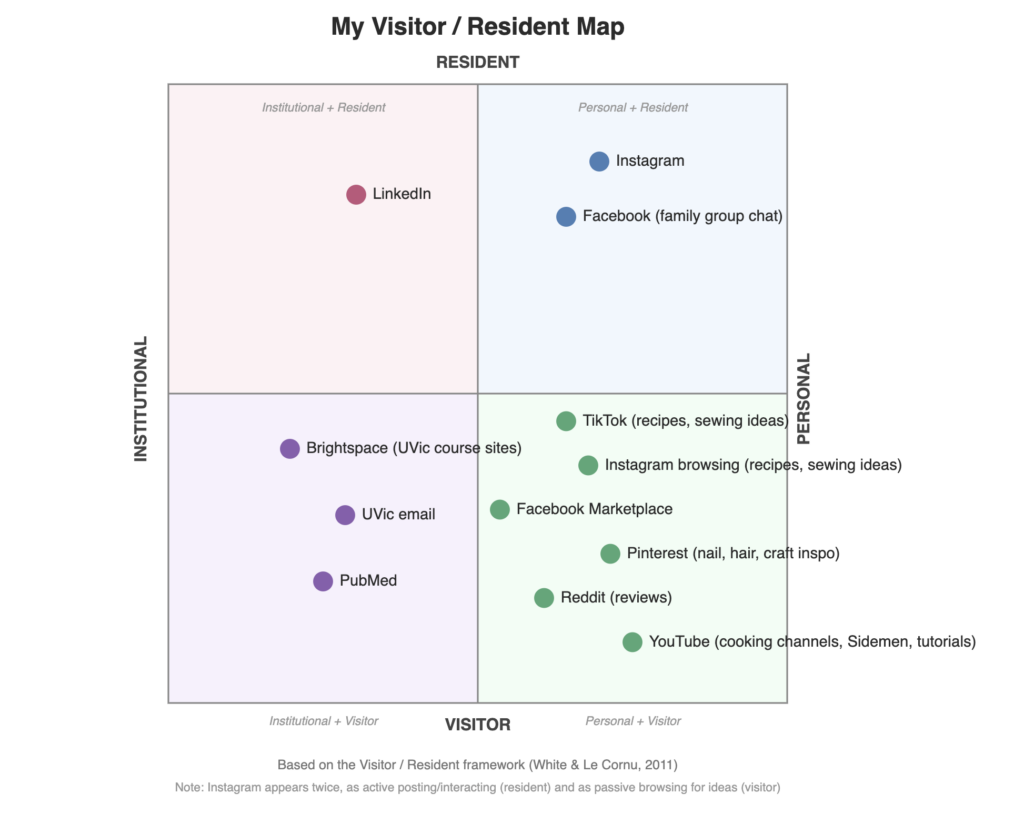
Making this map was a good excuse to actually sit down and think about how I use each platform. LinkedIn sits in the institutional/resident corner, since it’s tied to school and career rather than personal life, and I keep a profile there. Instagram is the clearest personal/resident platform for me; I post for my friends and actively interact with my friends’ and family’s posts. This is real, ongoing engagement rather than just passing through. Facebook splits in two depending on what I’m doing there. My family group chat is personal/resident since it’s genuine, regular interaction, but Marketplace is personal/visitor; I go in to buy or sell something and leave without any lasting social trace.
TikTok, Pinterest, Reddit, and YouTube all land on the personal/visitor side for me. I use TikTok and Instagram Reels for browsing recipes and sewing ideas, Pinterest for nail, hair, and craft inspiration, Reddit mostly for reviews before buying something or going to try a new restaurant, and YouTube for cooking channels, the Sidemen, and tutorials, but I never actually engage on any of them. No likes, comments, or posts, just consuming content and moving on. On the institutional/visitor side sit the tools I use out of necessity for school. These include Brightspace, my UVic email, and PubMed, which I use fairly often for research. None of these are really “social,” they’re task-based. I go in for a specific purpose and leave once I’ve got what I need. LinkedIn is the one institutional platform where I’m more of a resident than a visitor, even if I don’t use it as actively as Instagram.
What digital platforms are students currently using to develop their professional network?
For most students, LinkedIn is probably the clearest example, but a lot of professional network-building also happens more informally, through platforms that aren’t explicitly “professional” at all. Following researchers or programs, joining subject-specific groups, or being active in course-related online spaces all count. Looking at my own map honestly, LinkedIn is the closest thing I have to a professional network platform, but I don’t use it very actively; it’s more of a static profile than something I engage with regularly. PubMed rounds out the academic side, but that’s task-based research, not networking.
What could the student consider in expanding their professional learning network?
For me specifically, that would mean being more active rather than just keeping a static presence. Actually posting, commenting, or reaching out on LinkedIn instead of just having a profile would move me from what Rajagopal et al. (2011) would call “building” a network into “activating” it. It could also mean joining biology-specific communities or student groups online and following and engaging with researchers or programs I’m interested in.
How would an employer respond to your digital identity?
If an employer looked me up, I don’t think they’d find much at all. My Instagram is private, so that whole side of my online presence wouldn’t even be visible to them. What they’d most likely come across is my LinkedIn profile, which is mostly sitting static right now. That’s not necessarily a bad thing, since there’s nothing embarrassing to find, but it does make me think about whether I’m giving a future employer enough to go on if they’re trying to assess my fit for a role in a science-related field. It’s a good reminder that digital identity isn’t just about avoiding embarrassing content; it’s also about actively showing the professional side of yourself, which right now I don’t do much of.
How do data privacy and security limit and/or promote a PLN?
Regan and Jesse (2019) make the point that privacy in digital spaces isn’t just about hiding information; it’s about having control over how your information circulates and is used. That framing is useful here. On one hand, privacy settings and data protection let people participate in a PLN without feeling like everything they share is permanently and publicly exposed, which probably makes people more willing to engage in the first place. On the other hand, being too private can limit how visible and connectable you are within a network, which works against the whole point of building one. It’s a balance between being findable and being protected, and I don’t think there’s one right answer; it depends on what the network is actually for.
How can you create a digital identity reputation in your network?
Reputation in a PLN seems to come down to consistency and usefulness, showing up regularly, sharing or engaging with content that’s actually worth someone’s time, and being reliable enough that people know what to expect from you. It’s less about one impressive post and more about a pattern built up over time, which lines up with Rajagopal et al.’s (2011) point that maintaining a network is an ongoing activity, not a one-time thing.
Your PLN – Inclusion & Community Engagement
How diverse is your PLN?
Being honest, it’s a mix. On YouTube, I mostly go back to the same channels, cooking creators and the Sidemen, so that side of my consumption is fairly repetitive and narrow. Instagram and TikTok are different though, since the feed on both is more random; a lot of different creators show up that I’ve never followed or sought out on purpose. My friends and family also send me videos on both, which adds even more variety, since it’s content I wouldn’t have come across on my own. So it depends on the platform; some of my PLN is genuinely diversified by the algorithm and by the people around me, while other parts of it are pretty repetitive by choice.
Are you learning from a variety of diverse voices, and are you expanding your understanding of the views of others?
It depends on the platform. YouTube tends to reinforce what I already know and like, since I’m going back to the same channels rather than discovering new ones, which is a pretty common outcome of algorithm-driven platforms once you’ve trained it on your habits. Instagram and TikTok work more in my favour here; the randomness of the feed, plus what my friends and family share with me, means I’m exposed to creators and perspectives I wouldn’t have sought out myself. This week’s reading on public media being open, dynamic, and participatory (Clark & Aufderheide) made me think about the difference between a network that just reflects your existing interests back at you and one that’s genuinely participatory and open to other perspectives, and it looks like my own PLN does a bit of both depending on where I’m spending time.
What is a learning outcome of your PLN, and how are you ensuring your exposure to diversity and inclusion?
Right now, my PLN is mostly good for skill-building, better recipes, better technique, a clearer sense of what I’m doing in biology. It’s not doing much for exposing me to diverse voices or perspectives outside my usual interests. Going forward, that’s something I want to be more intentional about, actively seeking out creators and communities with different backgrounds and experiences rather than just letting the algorithm keep showing me more of the same.
How has your thinking about inclusion and PLN evolved?
Reflecting on inclusion in the context of a professional biology setting, this week shifted my thinking in a fairly simple way, I used to think of “diversity” in a PLN as a nice-to-have rather than something that actually affects the quality of what I learn. Moore and Schnellert’s point about unity coming through diversity, rather than in spite of it, reframed that for me. A PLN made up of similar voices might feel comfortable, but it also means missing out on different approaches to research, different lived experiences with the healthcare and science systems I hope to work in, and perspectives that would make me a better scientist and communicator.
Social media can play a real role here. It can be used to amplify voices and messaging that wouldn’t otherwise get much reach, which is a form of inclusion in itself, but it can just as easily be used to talk past people rather than with them. Whether a PLN is actually inclusive comes down to whether it’s amplifying other people’s views or just repeating your own back to you. It also means being aware, as an employee or future professional, that employers increasingly have expectations around how you communicate publicly, which adds another layer of responsibility to think through before posting.
The benefit of a genuinely diverse and inclusive PLN, as far as I can tell, is that it makes your understanding more complete. You end up with a fuller, more accurate picture of the field or community you’re part of, instead of just the version that already matches what you believed going in.
References
Rajagopal, K., Joosten-ten Brinke, D., Van Bruggen, J., & Sloep, P. B. (2011). Understanding personal learning networks. Their structure, content and the networking skills needed to optimally use them. First Monday, 17(1). https://doi.org/10.5210/fm.v17i1.3559
Regan, P., & Jesse, J. (2019). Privacy, ethics and security in digital spaces, developing awareness of privacy. Ethics and Information Technology.
Clark, J., & Aufderheide, P. Media and social justice, a new vision for public media, open, dynamic, and participatory.
Moore, S., & Schnellert, L. One without the other, stories of unity through diversity and inclusion.
White, D., & Le Cornu, A. (2011). Visitors and residents, a new typology for online engagement.
I really liked how clearly you explained your V&R Map and how your use of each platform can change depending on what you are doing. I thought your example of Facebook was especially interesting because you showed how the same platform can be both a resident and visitor space. Your reflection also made me think about how simply having a professional account is not always enough, and that actively engaging with others is what can help grow your PLN.